
AUTHORIZATION
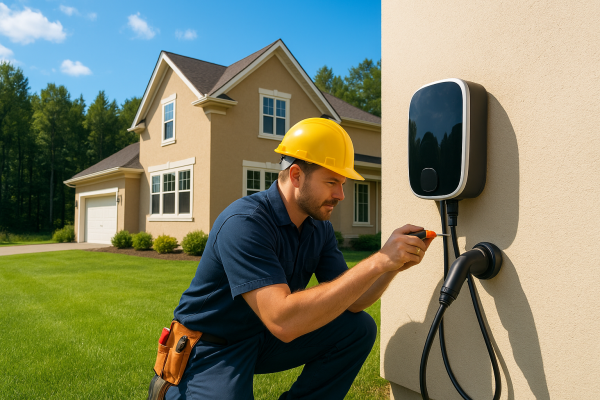
Installation of charging stations
Installation of EV charging stations: Key stages and technical nuances ????
The installation of electric vehicle (EV) charging stations is a complex electrical installation project that requires strict adherence to technical regulations and safety standards. The efficiency and reliability of the station directly depend on the quality of each work stage.
1. Preliminary inspection of the site (Technical audit)
The initial stage is critically important for making an optimal technical solution and reducing costs. It includes:
-
Assessment of the supply network:
-
Assessment of the available allocated electrical power at the site (kW).
-
Analysis of existing electrical installations, input cable, and distribution panel condition.
-
Determination of the need to modernize the input and distribution device (SS) or increase the allocated power.
-
-
Selection of installation site:
-
Evaluation of cable route options from the distribution panel to the charging station.
-
Considering environmental conditions (temperature, humidity, protection against vandalism) when choosing the station enclosure (IP class).
-
Ensuring free access for EV connection.
-
-
Equipment selection:
-
Determining the type of station (AC/DC, power from 3.7 kW to 22 kW) based on customer needs and audit results.
-
Choosing the connector type (Type 1, Type 2) and cable length.
-
Determination of the need to integrate a load management system to prevent network overload.
-
2. Development of the working project (Project documentation)
Based on the audit data, a working project is developed, which serves as a technical manual for installation:
-
Electrical diagram: Detailed connection diagram of the station, including the placement of circuit breakers, residual current protection devices (RCD), or differential circuit breakers with corresponding current ratings.
-
Equipment specification: An accurate list of basic and additional equipment, including cable brand, cross-section, and type, as well as materials and methods for cable route installation (trays, pipes, corrugated pipes).
-
Layout plan-diagram: A drawing showing the exact location of the charging station, SS, route, and grounding loop (if necessary).
-
Calculations: Performing thermal and current calculations to confirm the choice of cable cross-section and protective devices.
-
Cost estimate documentation: A detailed estimate of the costs for equipment and electrical installation work.
3. Execution of electrical installation work
The work is performed by qualified personnel, strictly adhering to the approved work project and electrical safety requirements:
-
Preparation work: Assembly of structural foundations, installation of cable routes.
-
Station assembly: Physical securing of the enclosure (to the wall or floor), installation of switching and protective devices in the panel.
-
Connection: Electrical connection of the station to the network.
-
Grounding organization: Assessment and, if necessary, organization of an additional grounding loop.
-
Adjustment work:
-
Insulation assessment: Measuring insulation resistance of cable lines with a megohmmeter.
-
Assessment of the grounding loop.
-
Testing of residual current protection devices/differential circuit breakers for disconnection.
-
Assessment of the station's operational capability in test mode with EV charging simulation.
-
Configuration of network connection (LAN/GSM) for control and monitoring (if provided).
-
4. Submission of documentation after the completion of works
After the installation is completed, the Customer is provided with a complete set of execution documentation confirming compliance of the installation with norms and the project:
-
Execution documentation: Actual connection diagrams, clarified routing and equipment layout plans.
-
Testing protocols:
-
Insulation resistance measurement protocol.
-
Grounding loop assessment protocol.
-
Protection devices activation assessment protocol.
-
-
Warranty obligations: Documents confirming the warranty for the equipment and work performed.
-
User manual: Technical manual for personnel on the safe and efficient use of the charging station.
Quality installation, adhering to all the listed stages, guarantees long-term and trouble-free operation of the charging infrastructure.
Get in touch
Your Name
E-mail*
Phone*
Region
Message Text*
Insert photo


